Saturday, January 17, 2009

Ending the Coaching Carousel

One of the great things about college football is there are four seasons within any calendar year. It starts with Bowl Season around New Years, then you have Recruiting Season on National Signing Day in early February, then the actual season in the fall that we all live for. Finally, at the end of every season but before bowl season, we have the annual circus that revolves around coaches getting fired and coaches leaving jobs. Ironically, the coaching carousel gets fans as worked up as any other part of the season. Last season, it was WVU fans losing it over RichRod leaving for Michigan. This year, we had Lane Kiffin to Tennessee and Gene Chizik to Auburn as the two high profile coaching jobs, along with the drama of whether Charlie Weis would be kept on at Notre Dame. But, then we had BC suddenly enter into this mix last week when coach Jeff Jagodzinski was fired for interviewing with the New York Jets.

Now, I'm not going to blame either side for causing the coaching carousel. In colleges, there is a clear hierarchy. Some schools get better students, some schools get better faculty members. In academia, money follows prestiege in endowment, facilities, and salaries. You'd never fault a professor for leaving his tenured position at Minnesota for a job opening at Harvard, it's clear which job is better. This holds true for coaching jobs as well. BCS schools get better athletes because they have more money and better facilities, so coaches leave jobs in the MAC and CUSA for BCS jobs all the time. Coaches also leave some BCS jobs for the really "big" jobs-- Notre Dame, Michigan, Ohio State, Alabama, Texas, Oklahoma, USC-- because they have the combination of money, history, prestige, facilities and fan bases, or if they leave for the NFL. When coaches jump ship for "bigger" jobs, it's no different than faculty members jumping. It's part of the business, and I don't fault the coaches for jumping from one job to another.

Now, I also don't blame BC AD Gene DeDeFillipo for taking a stand with Jagodzinski. If I was the AD at a school like BC, and I was only two years removed from losing coach Tom O'Brien to a parallel coaching move to NC State, I'd be fed up as well. The thing is, structurally, something has to change in the hiring process to prevent the carousel from staying at the ridiculous levels it's been the past couple of seasons.

Let me tell you a story. My parent's recently got a new kitten named Biscuit, who while adorable, has drawn the ire of our current cat Maizey. Maizey is emotionally fragile, as she was already taking feline anti-depressants (not joking) and had survived a wild dog attack (not joking), so having a new cat did not go over well with her. Biscuit was found in a dumpster, so she's got a bit of street fighter in her as well. Well, one day when my mom came home from work, she found Maizey waiting for her at the door, looking absolutely disgusted. It turns out that Biscuit had grown tired of Maizey's bullying, so she got revenge: she pissed in the cat's communal water dish. It then became a prisoner's dilemma. Both cats were in a contest to see who could piss in the dish first, since neither could trust the other not to do it.

This is what has happened with the coaching business-- it's become a pissing contest. AD's aren't willing to give coaches 5 years anymore to build a program with their own recruits. It's win now or fired (see: RichRod next December if Michigan goes 6-6). With coaches, they want the prestige jobs with big money, and they also know that you may only get one chance to land one of those jobs so they leave as soon as they are offered. The hope on both parts was the "buyouts" in the contract would prevent the carousel. Buyouts are a percentage of the contract that either side has to pay if they leave before the contract ends. RichRod's at WVU was $4.5 mil, so he had to pay it when he left early. Tommy Tuberville's at Auburn was $5.1 for "resigning," which Auburn had to pay for not letting him finish the contract. Good ideas, but obviously it's not working.

So how do we stop the pissing contest? Simple. Guarantee the coaching contracts. Eliminate the buyout and put all the money on the table. If you get fired 3 years into a 5 year, $10 mil contract, the AD owes you a $4 mil check. If a coach pulls a Bobby Petrino and leaves after one year of a 5 year, $15 mil deal, the coach owes the school $12 mil. It makes the economics of the whole thing a lot more realistic. It will force schools to give coaches the chance to actually build a program, while also forcing school to wait for the right promotion, and not to jump at the first one they get out of fear it'll be the only one they get.

Tuesday, January 13, 2009

Gladwell breaks down the 2008 Longhorns

Malcolm Gladwell, best-selling author of Blink, Tipping Point, Outliers, and -- most recently -- Context: History's Kingmaker, spends a chapter in Context discussing the 2008 Longhorns football team. An excerpt from that chapter is reprinted below.

At first glance, seeing the tradition and resource rich Texas Longhorns ranked in the top five at season's end hardly seems a surprise. Texas under head coach Mack Brown has finished seasons ranked sixth or better five times this decade, won five straight bowl games (including three BCS Bowls), and a national championship. The Longhorns' recruiting classes annually rank among the nation's very best and their training facilities are second to none. Of course they finished ranked in the top five, right? To borrow a famous college football catchphrase: Not so fast my friend.

What if I told you that Texas began the season ranked outside the top ten and was predicted to finish fourth in their conference? Or that they were regrouping under their fifth defensive coordinator in five seasons? What about the fact that the Texas hadn't defeated the lowly Aggies since their superstar QB Vince Young turned pro? Would you still say the 2008 Longhorns were predestined for top five success?

Probably not, and to understand why Mack Brown for the first time in his Texas career exceeded expectations, we have to dig deeper. We need what I call... context.

1.
The casual fan will peddle a surface-level explanation for Texas' success by pointing to the arrival of defensive guru Will Muschamp. That's not untrue, but to appreciate fully what that actually means we need to look much closer at the events that led to his being hired at UT.
If you weren't paying attention, you might think Will Muschamp just parachuted into Austin as if gifted by a stork. But that is not at all what actually happened. Will Muschamp's arrival in Austin was the last step in a long chain of events that began many years ago, every one of which a critical link in the chain. Let's start from the beginning.

[Discussion of Big Bang and rise of civilization omitted for length.]

From the key developments during the Paleolithic Period to the terror of the early 20th century Russian gulags, the very course of history shaped this story. Take away any of it and Mr. and Mrs. Muschamp never birth that child in their rural Georgia home. Context.

And what of Muschamp's predecessors in Austin? Was it predestined that both Gene Chizik and Duane Akina would be intellectually incapable of grasping the stupidity in trying to defend pass spread offenses with three bulky, slow linebackers? Of course not. To understand why Robert Killebrew was allowed to start over Rodderick Muckelroy, you'd need to know just how good Killebrew's salmon soufflet really was. And to understand that we'd have to go back to the time in Kill's childhood when his grandmother decided to sew him his first apron.

Remember the dog that chased the cat that caught the mouse that ate the cheese.... Context.

2.
Anybody who watched Texas this year knew that their offense struggled mightily in two critical regards: rushing the football and completing long downfield passes. Deficient in both, Texas only chance at being offensively explosive lay in executing the short passing game to absolute perfection. That is precisely what they did, as junior quarterback Colt McCoy broke the NCAA record for completion percentage in a season.

Was Texas simply fortunate to have on hand the right quarterback for the right season?

Perhaps... but perhaps not. Let's again dig a little deeper.

In 2002 a group of Swedish social scientists studied quarterbacks from small towns (2,500 or fewer residents) as part of their effort to estimate the chances one of their countrymen could make it to the National Football League as a passer. What they discovered is that there exists a direct inverse relationship between a quarterback's accuracy as measured by completion percentage and the size of his hometown as measured by population. Think about how astounding that is: The smaller your hometown, the better your accuracy throwing a football.

What is going on here?

The answer lies in behavioral economics. There are several relevant handicaps for a quarterback who grows up in a very small town. First, there are far fewer children around who are his age. Second, because job prospects are more modest in small towns, he is more likely to be economically disadvantaged. Third, and relatedly, the schools in his small town are less likely to have the resources and facilities that kids from bigger cities typically enjoy. Taken together, the small town kid who grows up wanting to be a quarterback has to train differently than he would in a bigger town. Most importantly, he will spend more time playing by himself. Without enough kids with whom he can practice and play -- not to mention a lack of training/practice facilities he can access year-round -- the rural quarterback hopeful winds up practicing drills on his own.

Without money for anything fancy, he throws the football through a tireswing. Or he creates imaginary receivers who run imaginary routes, rewarding himself by imaginary rules that require he toss the football in just the right spot.

While other quarterback hopefuls are playing sloppy games of neighborhood ball, the rural player is forced to find fun in exercises that are, at root, accuracy drills. Context.

Soon after the Swedish academics published their study in the obscure Journal Of Socioeconomic Rural Studies, a 23-year old Ph.D. candidate in economics happened across it during the course of his dissertation research on the intersection of football and religion in rural America. Can you guess the university in which he was enrolled? You're right -- it was the University of Texas-Austin. And his name? It was Chris Jesse. His relationship to Mack Brown? He is the Texas coach's stepson. Context.

As Mack Brown tells it, Jesse's discovery of the Swedish study wound up having a huge impact on Texas' recruiting strategy during 2004-05. "Late in the 2004 recruiting season I got this call from Chris and he's talking so fast I can barely understand him," Brown explains. "Chris is a pretty impulsive and excitable fella, so I didn't think much of it, but I told him to come to my office the next day and explain whatever it was that had him all riled up."

Jesse met with Brown over lunch and laid out what he'd learned. "The enormity of the implications of what Chris was telling me were immediately apparent," Brown continues. "When he was through explaining it we both sort of looked at each other and said simultaneously: Colt McCoy."

Colt McCoy -- a senior quarterback prospect from Tuscola, Texas, population 714. Colt McCoy, who grew up throwing footballs through a tire swing because there weren't enough kids with whom he could play. Colt McCoy, who quarterbacked his tiny 2A team to a state title but received only the scantest of attention from recruiting services like Rivals and Scout.

"As I recall, we'd just lost John Brantley to Florida," Brown says wistfully. "And suddenly we're presented with this evidence that small town quarterbacks are born and bred to throw darts. I'm not sure who was more surprised when we made Colt a scholarship offer -- McCoy himself, or our fanbase. Nobody had any clue who he was or why we wanted him."

Four years later, McCoy now owns most of the passing records at the University of Texas, along with the new national benchmark for completion percentage. The two-star quarterback from Nowhere, Texas was the perfect fit for the 2008 Longhorns. But how did Brown know he'd need McCoy's specific talents?

Mack Brown chuckles as he recalls the decision-making process. "Early in 2006 I'd sat down with Greg Davis and we looked carefully at what the roster was likely to be for the next two, three, and four years. The first thing that stood out is that we didn't have much confidence we were going to be able to figure out how to thrive passing and running the ball together at the same time. Outside Vince's senior year, I'm not sure Greg and I have ever been able to do that," Brown laments. "And the second thing we noticed was that we were going to have a downfield problem with our receivers. I asked Greg if Malcolm Williams, who we were recruiting at the time, would be ready by '08 and he said definitely not. And so we sort of came around to the idea that the hyper-accurate, underneath passing game was where we were headed."

When the coaches explained this to the other quarterback prospect on the roster, true freshman Jevan Snead, he saw the writing on the wall and wound up transferring to Ole Miss. And with that, everything was set for McCoy's run to the record books.

Remember the dog that chased the cat that ate the cheese...

Context.

Monday, January 12, 2009

Looking Ahead to 2009


This picture sums up how I feel every January. Alone, violated, despondent, a sense that there is no hope for the future-- and apparently, possibly attractive but unwilling to wear anything other baggy clothes so really, I'm kinda just annoying to look at for a long time. I mean honestly, what do I have to hide? And seriously, I'm in a beret-wearing phase (go to 1:35 mark).

Anyways, back to my point. Once again, we as a nation are forced to face the harrowing prospect of starting a new year with nine months devoid of organized intercollegiate football games. It's scary.

Ahh, this always makes me feel better: a hampster dressed like Rambo. Yes, now I can put my fears about 270 days without football to bed, since I will now instead by kept up late at night worried that these furry creatures are preparing for their own guinea-rilla warfare. Could it happen? Well, would you believe that this year's national champion would cut foreskins as part of his off-season workout? Yeah, seems a whole lot more real now, doesn't it?

We want you to know that despite the lack of games, we are not going to ease up on our poorly thought out and weakly defended opinions here at Office Tailgate. We will still update multiple times per week to fuel discussions here at our digital office water cooler, but we'd like to hear what you're interested in. Do you want stories on football recruiting, basketball insights, to introduce you to the hockey Frozen Four? Let us know, and feel free to be abusive. After all, like a redneck woman with low self-esteem, the only way we'll change is if you are savagely beat us and then later, half-heartedly, say you love us. So please, leave some comments and suggestions. At the very least, it'll be nice to hear we have a readership beyond my girlfriend.

Sunday, January 11, 2009

National Championship Game Thoughts


I know it's a couple of days after the fact, but I have to work for a living and did not want to put up a post until I saw my final "Take a Te-Bow, Tim" montage from all the major TV networks of the season. Here are my thoughts on the national championship game.

- I thought the game was awesome. It had great defense, offense, special teams-- it was just a great game to watch. It was an entertaining game with a little bit of everything. While I wish that Oklahoma had scored one last time in the fourth to make it a one possession game, it was a great ending to another entertaining college football season. I'm also not alone apparently, as it earned the highest ratings in BCS title game history.

-- That being said, it was a really sloppy game. A lot of penalties on both sides, a lot of miscues on the field. The layoff between games has just gotten ridiculous, and it hurts the final product on the field. I'd much prefer wrapping up the games by Jan 3 at the latest.

--Time to address the Tebow situation. Personally, the game was exactly as I expected. He played pretty well, but I will never understand why he's considered such a great player. I understand he's a terrific person and ambassador for the sport, and I understand that he's a proven winner in both high school and college. His resume is great, but I do not get why we consider him to be "arguably the greatest college player ever." While Optimus Prime and I love to make Hoogs spontaneously combust by telling him that Tebow is better than Vince Young, he really seems to be simply an above average quarterback on an excellent team. He isn't all that fast, he isn't all that accurate, in fact the only thing I can see that sets him apart is that when he's tackled he always seems to fall forward for an extra two yards (unless it's 4th and 1 against Ole Miss).

For me, the game solidified that he's not going to make it in the NFL as a quarterback. He's not that fast, so it's not like he's a Vick-esque QB. He never completed any pass longer than 12 yards in the air, his first INT on a throw from the harsh mark to the far sideline showed he doesn't have the arm to make it in the NFL, and his second on a OU zone blitz showed he can't read defenses.

Finally, to all the media members like Scott Van Pelt that are shocked that so many people were rooting for Tebow to fail: understand that you created this monster. The American population is telling you that they are sick of Tim Tebow. Yes, he's a great person, but when he's the only person you talk about for the past three years (it started when he as a RB on the Chris Leak-led 2006 Gators), people get fed up. I'm not going to go into detail about how sickening the treatment of Tebow was during the game, Deadspin and others have already done so, but there is going to be a backlash. People now root for Tim Tebow to fail because it's the only way ESPN, SI, Fox, CBS and anyone else affiliated with sports TV will shut up about him. They don't root against a good kid, they root for whatever scenario will result in hearing about the rest of the players in college football. Remember: he's not even the best skilled position player on their offense, as Percy Harvin showed, let alone the best player in college football.

-- The National Championship was won by the Florida secondary and Brandon Spikes. Watching that game, I thought that Spikes showed that he is going to be the best player from either team in the NFL. He was everywhere-- blitzing, run defense, pass defense-- and was key to shutting down the OU offense juggernaut. The Florida secondary also played lights out the entire game, of course highlighted by Ahmad Black's amazing pick off Jaquian Igeslias. While the goal line stand gets a lot of credit (more on that below), the bigger key to Florida's success was the secondary shutting down TE Jermaine Gresham in the second half. A lot of credit goes to defense coordinator Charlie Strong, even if he does have jungle fever.

-- Oklahoma was going to lose when they were stopped on 4th and 1 from the goal line. When they missed that opportunity to close the game in the first half, you knew it wasn't going to be their night. When they also failed to score after getting second life off a roughing the punter call in the third quarter, when they were stopped again after another predictable off tackle run on third and short, you got that feeling again.

-- People like Kirk Herbstreit have defended Colt McCoy all year by saying that he had less talent around him than Sam Bradford. After watching this game and the Fiesta, I'm not so sure. I think I'll take Crosby and Shipley over just about any WR on the OU roster right now. It only makes Bradford look more impressive in my opinion, since he threw for those ridiculous numbers with only a tight end.

-- If I hear one more person write, "Well, this shows they don't play defense in the Big 12," I'm going to puke. Really? Why don't we say the same thing about the SEC. Georgia (49 points), LSU (51 points), South Carolina (56 points), Vandy (42 points) et al? They all seemed to look pretty pathetic on defense during the season. The two teams that held Florida to it's lowest outputs of the season: Miami and Oklahoma, neither of which are in the SEC. Time to quit the obsession with the SEC, now you're just making excuses for them.

Friday, January 9, 2009

Big Game Boob

Another choke by Stoops? Was this his fault or did his team simply fail to execute (everyone is looking at you, Juaquin "Butter Fingers" Iglesias)?

Wednesday, January 7, 2009

They're Going Pro? Bull-shitzu


Now that the college football season is ending, we are getting the annual list of college football players announcing that they are heading to the NFL a year early. Some like Iowa running back Shonn Greene and Alabama pro/left tackle Andre Smith have already announced that like a debutante on the last stair, they're "ready for the next step."

Two big announcements came today from my new home state of Georgia, as both QB Matthew Stafford and RB Knowshon Moreno have announced that they are taking their game, and I'm sure their undiagnosed cases of genital herpes (it's all about suppression), to the NFL.

If I can be as blunt as Michael Jackson, who ain't gonna live his life as a color, this is a very black or white decision. On the one hand, you have Knowshon Moreno. He has been one of the five best RBs in college football the last two years. Last year he had 1336 yards, this year he had 1400. Last year he average 5.4 yards per carry, this year he averaged 5.6. 14 TDs last year, 16 TDs this year. Last year his long run was 80 yards, this year it was 68 yards. He has very good size at 5'11" 207 lbs, but more importantly, he went through the past two years in the SEC as UGA's primary running back without surviving any major injury. This guy is an awesome talent and worthy of being a top 15 pick. He should leave early, since as a running back he has a short shelf life to begin with and staying for another year and taking 30 handoffs a game won't exactly extend the ol' career.

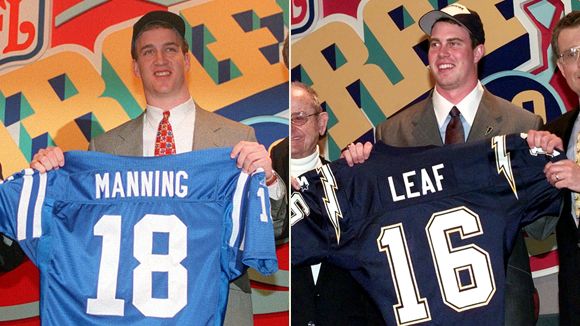
And on the other hand, you have Matthew Stafford. Let's play a game. Close your eyes. Let's pretend you have a college quarterback. Let's say he has great size, say, 6'3" 237 lbs. Let's say he also has great numbers: threw for 3500 yards, 25 TDs, and had a QB rating of 153.5. Let's also say he has a rocket arm. Let's also say that he makes a lot of bad decisions, like 10 INTS and took 17 sacks this year. Let's say in big games, like against Florida, he threw of 0 TDs and 3 picks. Let's say most of his numbers came in garbage time. He makes awful decisions. He has a great arm, but makes terrible reads and forces passes all the time. If I told you all this, you know who you'd think of? Ryan Leaf. Akili Smith. Tim Couch (PS, yes that's autographed. What's missing form the photo is the card: "To Mom and Dad-- May Your Life, Like My Career, Be a Perfect Downward Spiral. Love, Tim Couch #2. PS- I took out the garbage).

Stafford is a great talent. He has all the tools you could ever want, seems to be a good athlete, but he's not ready for the NFL. He needs another year in a pass happy offense, which UGA will be without Knowshon-ing who will run the ball, to learn how to read defenses. Also, by coming out this year, congrats: you're going to the Detroit Lions. I'm a Browns fan, and even I can make fun of the Lions. Basically, he's decided to take $60 million contract in exchange for being a cripple for the rest of his life. Like milk on a hot day, this was a poor choice.

A guy can dream (My hope for the NCG)

Wouldn't it be great to see an epic battle tomorrow night? I think it would.
But wouldn't it be better to see that epic battle end in this final score:

Florida 45
Oklahoma 35

Karma is a bitch.